Wednesday, February 17, 2016

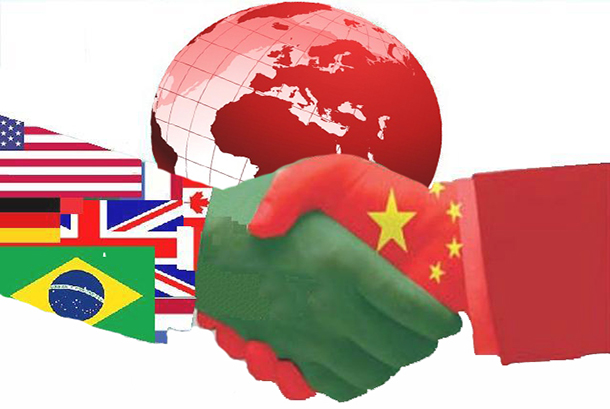
China and the Global Economy


                                                Comments due by Feb. 26, 2016
Weighed down by currency fluctuations, stagnant demand and volatility among commodities, international trade ultimately will hamper and constrict global economic growth this year, according to a report released Monday by the Organisation for Economic Cooperation and Development.
The OECD releases a handful of reports each year to highlight its short- and long-term growth projections, and Monday's report marks the second consecutive downward revision of note in the last few months.
In part because of a "deeply concerning" negative trend in trade growth, the organization bumped down its 2015 economic expansion estimate to only 2.9 percent from September's 3 percent, OECD Secretary-General Angel Gurría said in a statement Monday. That September headline number already had been bumped down from a 3.1 percent projection in June.
For comparison's sake, the global economy grew by more than 3.3 percent in 2014 and by nearly 3.2 percent the year before. Should 2015's projection hold, it would be the worst year for global growth since 2009.
"Since the crisis, we have become used to a familiar pattern: springtime optimism followed by downgrades in growth forecasts as the year progresses. 2015 is no different," Gurría said. "Global trade, which was already growing slowly over the past few years, appears to have stagnated and even declined since late 2014, with the weakness centering increasingly on emerging markets, particularly China. This is deeply concerning, as robust trade and global growth go hand in hand.
"Over the past five decades, there have been only five other years in which trade growth has been 2 percent or less, all of which coincided with a marked downturn in global growth," Gurría said, noting that "the slowdown in China" is "hitting activity in key trading partners."International trade is expected to expand by only 2 percent this year, according to the OECD. That's down significantly from the 3.4 percent trade growth seen in 2014 and would be one of the worst expansion numbers the world has seen in years.
China for years has been considered an international commerce titan, but the country's import and export numbers have been going downhill fast in recent months. Trade data released Sunday showed Chinese exports in October were down 6.9 percent year over year, markedly worse than the 3.7 percent shortfall seen in September. Imports, meanwhile, plunged 18.8 percent year over year.
Exporting nations who have relied on Chinese firms and consumers to buy their products have mostly fallen on hard times in response. Russia and Brazil, in particular, are examples of nations who have slipped deeper into recession as Chinese demand cools. The OECD projects the Russian economy will contract 4 percent this year, while the Brazilian economy will shrink 3.1 percent.
But those countries are essentially getting hit with an economic double whammy from China. Not only are Chinese industries buying smaller quantities of their goods, but because China accounts for such a huge percentage of global commodity consumption, a slowdown there will affect prices around the world. Commodity exporters like Brazil and Russia are now forced to sell their products at a cheaper rate worldwide just to make a sale, which means their profit margins even outside of China are vulnerable.Both nations are heavy exporters of raw materials and commodities like iron ore and crude petroleum. Brazil exports more products to China than it sends to any other nation, according to the Observatory of Economic Complexity. And China is the second-most popular destination for Russian exports, according to the OEC.
"Europe and the U.S. are small industrial commodity users compared to China. China consumes almost 50 percent of global industrial commodity consumption. And so if China slows down, the demand for industrial commodities goes down," Swiss investor Marc Faber said in an interview earlier this year on CNBC's "Trading Nation." "It affects all of the resource producers."

America is largely shielded from trade fluctuations because its economy is primarily consumer-driven rather than export-dependent. The OECD notably didn't revise U.S. growth down at all in its latest series of projections, highlighting America's reliance on consumer spending rather than trade to push its economy forward.
That includes Canada as well. America's neighbor to the north slipped into a recession earlier this year in part because of pricing and demand volatility for some of its primary exports. Minerals, metals and precious metals – all of which have been vulnerable to price fluctuations in recent months – account for nearly 41 percent of Canada's exports, according to the OEC.
Still, a weakened and volatile international marketplace can change the dynamics of how the U.S. does business on a global scale. Data from the Census Bureau in September showed China surpassed Canada as America's No. 1 trade partner so far this year in terms of goods alone.
Canada had long enjoyed a trade relationship with the U.S. that no other country could match, but China this year managed to shake Canada loose. American imports of Canadian goods were down more than 10.5 percent in the first nine months of the year compared with the same window last year, largely a result of further depressed oil prices in 2015.
Canadian trade with the U.S. could have been bolstered by the controversial Keystone XL pipeline extension project that had been batted around for years before President Barack Obama ultimately declined to grant his necessary approval last week. The pipeline would have stretched nearly 1,200 miles and helped to connect oil facilities in Western Canada with the Gulf Coast. Conservatives counting on the deal to generate temporary jobs and bolster America's diminished oil industry were far from pleased with Obama's move.
"The long-term growth of the U.S. economy is intimately linked to our trade and investment relationships with Canada and Mexico," Matthew Rooney, director for economic growth at the George W. Bush Institute, said in a statement Friday. "How can it not be in our national interest to build the roads, bridges and pipelines that carry those goods and services?"
Those hoping global growth would be jump-started by a massive U.S.-Canada pipeline project now will need to look elsewhere. And while the OECD expects trade and overall growth to pick up in 2016 and 2017, there's still a lot of time for conditions to turn south.
"The global outlook is something of a good news/bad news story," a team of researchers at IHS Global Insight wrote in a research note last month. "The good news is that the (known) threats to global growth will likely not kill the expansion. The bad news is that any acceleration could easily get delayed another year."  (US News)

Thursday, February 11, 2016

TPP Is it helpful?


                                             Comments due by Feb. 19, 2016

Lawmakers and presidential candidates are having their say about the 12-nation Pacific Rim trade accord that is President Obama’s top economic priority in his final year in office. But lately the liveliest debate over the deal is among blue-ribbon economists.
On Monday, it was the critics’ turn: Economists from Tufts University unveiled their study concluding that the pact, called the Trans-Pacific Partnership, would cause some job losses and exacerbate income inequality in each of the dozen participating nations, but especially in the largest — the United States.
Supporting the authors at the National Press Club was Jared Bernstein, who was the top economic adviser to Vice President Joseph R. Biden Jr. during Mr. Obama’s first term.
Each side in the economists’ debate has criticized the economic model that the other used to reach its results, while opponents and supporters of the trade accord have quickly seized upon whichever analysis buttressed their own views.The conclusions of the Tufts economists contradict recent positive findings from the Peterson Institute for International Economics and the World Bank about the trade pact, which would be the largest regional accord in history and would bind nations including Canada, Chile, Australia and Japan.
Michael B. Froman, Mr. Obama’s trade representative, plans to join other trade ministers in Auckland, New Zealand, on Thursday for the formal signing of the trade deal, which they finished in October after years of negotiations.
The future of the deal, however, depends on the approval of a sharply divided Congress. The administration is believed to lack enough support for passage, though votes are not expected until after the November election. Some other nations are delaying their own ratification processes pending American action.
Election-year pressures are not helping the president’s cause, as leading candidates in both parties are opposing the trade agreement.
Donald J. Trump, the leading Republican candidate, told the conservative website Breitbart News over the weekend that as president he would stop what he called “Hillary’s Obamatrade.”
Hillary Clinton, the leading Democratic contender, has criticized the final agreement after praising it while it was being negotiated. She continues to be assailed by her main rival for the nomination, Senator Bernie Sanders of Vermont, for her early support.
Against this backdrop, the economists from prestigious universities and research institutions have been providing their takes and debating their differences just as intensely, though with more scholarly reserve.
The analysis from the Global Development and Environment Institute at Tufts was titled “Trading Down: Unemployment, Inequality and Other Risks of the Trans-Pacific Partnership Agreement,” and was written by the economists Jeronim Capaldo and Alex Izurieta, with Jomo Kwame Sundaram, a former United Nations economic development official.
The authors wrote that they used “a more realistic model” for their analysis, and that previous reports that projected economic benefits from the trade accord were “based on unrealistic assumptions such as full employment” and unchanging income distribution.
The Tufts report projected that incomes in the United States would decline by a half-percentage point compared with the change expected without the Trans-Pacific Partnership. The Peterson Institute’s report, by economists from Brandeis and Johns Hopkins universities, projected that incomes would rise by half a percentage point.
The Tufts paper also projected that the overall economies of the United States and Japan would contract slightly. Employment in the United States would decline by 448,000 jobs; total job losses in the dozen nations would be 771,000 — a small share of the nations’ total work forces, yet hardly a selling point for leaders seeking to ratify the trade agreement.
The Obama administration has acknowledged that some jobs would be lost, especially in manufacturing and in industries that employ workers with lower skills, but it has said that those losses would be offset by new jobs created in export-reliant industries that pay more on average. The Peterson Institute report offered evidence for that argument, while concluding that there would be no net change in overall employment in the United States.
The other parties to the pact are Mexico, New Zealand, Peru, Malaysia, Vietnam, Singapore and Brunei.
“Economic gains would be negligible for other participating countries — less than one percent over 10 years for developed countries, and less than three percent for developing countries,” the Tufts report said.
It also had bad news for countries, including China, that are not parties to the Trans-Pacific Partnership, whose participants account for nearly 40 percent of the world economy.
“We project negative effects on growth and employment in non-T.P.P. countries,” the report said. “This increases the risk of global instability and a race to the bottom, in which labor incomes will be under increasing pressure.”


The authors’ explicit criticism of models and data used by other economists provoked swift counter-criticism. Robert Z. Lawrence, a professor of international trade and investment at the Kennedy School of Government at Harvard, and a senior fellow of the Peterson Institute, wrote a blog pieceon Monday expounding on why the institute’s analysis was “superior on all counts” and better suited to specifically gauging the impact of megatrade agreements.

Monday, February 1, 2016

Extreme Weather and Global growth


                                                 Comments due by Feb 12, 2016


 Until recently, the usual thinking among macroeconomists has been that short-term weather fluctuations don’t matter much for economic activity. Construction hiring may be stronger than usual in a March when the weather is unseasonably mild, but there will be payback in April and May. If heavy rains discourage people from shopping in August, they will just spend more in September.

But recent economic research, bolstered by an exceptionally strong El Niño – a complex global climactic event marked by exceptionally warm Pacific Ocean water off the coast of Ecuador and Peru – has prompted a rethink of this view.


Project Syndicate needs your help to provide readers everywhere equal access to the ideas and debates shaping their lives.
LEARN MORE
Extreme weather certainly throws a ringer into key short-term macroeconomic statistics. It can add or subtract 100,000 jobs to monthly US employment, the single most-watched economic statistic in the world, and generally thought to be one of the most accurate. The impact of El Niño-related weather events like the one this year (known more precisely as “El Niño Southern Oscillation” events) can be especially large because of their global reach.
Recent research from the International Monetary Fund suggests that countries such as Australia, India, Indonesia, Japan, and South Africa suffer adversely in El Niño years (often due to droughts), whereas some regions, including the United States, Canada, and Europe, can benefit. California, for example, which has been experiencing years of severe drought, is finally getting rain. Generally, but not always, El Niño events tend to be inflationary, in part because low crop yields lead to higher prices.
After two crazy winters in Boston, where I live, it would be hard to convince people that weather doesn’t matter. Last year, the city experienced the largest snow accumulation on record. Eventually, there was no longer any place to put it: four-lane highways narrowed to two lanes, and two-lane roads to one. Roofs collapsed and “ice dams” building up from gutters caused severe flooding. Public transport closed, and many people couldn’t get to their jobs. It was a slow-motion natural catastrophe that lasted for months.
The US as a whole did not have a winter as extreme as New England’s in the first part of 2015, and the effects of the weather on the country’s overall economy were subdued. True, New York City had some significant snowfalls; but no one would have paid much attention had the mayor been more competent in getting the streets plowed. Eastern Canada suffered much more, with severe winter weather playing a role (along with lower commodity prices) in the country’s mini-recession in the first half of the year.
This year’s winter is the polar opposite of last year’s. It was 68º Fahrenheit (20º Celsius) at Boston’s Logan Airport the day before Christmas, and the first speck of snow didn’t come until just before New Year’s Day. Trees and plants, sensing spring, started to blossom; birds were just as confused.
Last winter Boston was something of an anomaly. This year, thanks in part to El Niño, weird weather is the new normal. From Russia to Switzerland, temperatures have been elevated by 4-5º Celsius, and the weather patterns look set to remain highly unusual in 2016.
The effect on developing countries is of particular concern, because many are already reeling from the negative impact of China’s slowdown on commodity prices, and because drought conditions could lead to severe crop shortfalls. The last severe El Niño, in 1997-1998, which some called the “El Niño of the Century,” represented a huge setback for many developing countries.
The economic effects of El Niño events are almost as complex as the underlying weather phenomenon itself and therefore are difficult to predict. When we look back on 2016, however, it is quite possible that El Niño will be regarded as one of the major drivers of economic performance in many key countries, with Zimbabwe and South Africa facing drought and food crises, and Indonesia struggling with forest fires. In the American Midwest, there has lately been massive flooding.
There is a long history of weather having a profound impact on civil strife as well. Economist Emily Oster has argued that the biggest spikes in witch burnings in the Middle Ages, in which hundreds of thousands (mostly women) were killed, came during periods of economic deprivation and apparently weather-related food shortages. Some have traced the roots of the civil war in Syria to droughts that led to severe crop failure and forced a mass inflow of farmers to the cities.
On a more mundane level (but highly consequential economically), the warm weather in the US may very well cloud the job numbers the Federal Reserve uses in deciding when to raise interest rates. It is true that employment data are already seasonally adjusted to allow for normal weather differences in temperate zones; construction is always higher during spring than winter. But standard seasonal adjustments do not account for major weather deviations.
Overall, the evidence from past El Niños suggests that the current massive one is likely to leave a significant footprint on global growth, helping support economic recovery in the US and Europe, while putting even more pressure on already weak emerging markets. It is not yet global warming, but it is already a very significant event economically – and perhaps just a taste of what is to come.(Project Syndicate)