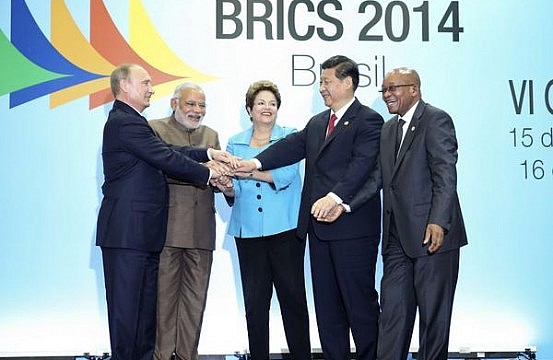
The eyes of the world has focused recently on Brazil,which hosted an event that may prove in time to be the beginning of a grand project in global affairs. It wasn’t the World Cup, though. On July 15, Brazil organized the sixth meeting of leaders of the BRICS nations – Brazil, Russia, India, China and South Africa – and, following that, a meeting among the BRICS and the leaders of South America.
Since 2009, BRICS leaders have been gathering in what has primarily been a symbolic exercise, highlighting and promoting the idea that a strategic shift is underway in the global economy from the developed to the largest and fastest growing developing economies, which will require recalibrating global governance and political leadership. However, as developed economies have slowly recovered from the financial crisis and the BRICS nations have slowed, the utility of largely symbolic meetings has been questioned to the point where the importance of the BRICS itself is unclear to many but the most dedicated advocates.
This changed recently in Fortaleza, Brazil, as the BRICS leaders advanced an agenda of concrete actions, including the establishment of a $50 billion BRICS “New Development Bank” and a $100 billion contingent reserve arrangement designed initially to address global balance of payments pressures within the bloc. Operations are planned to begin in 2016. Given China’s overwhelming economic size vis-à-vis its BRICS partners (some 70 percent of overall GDP), Beijing’s voice will carry greater weight on issues of highest importance. For example, after much debate, the location of the new BRICS bank will be Shanghai; compromise was reached on the leadership, which will rotate among the founding five members.
At the same time, the implications of an international financial institution underwritten by the BRICS are uncertain but potentially significant. It is unclear whether the bank will directly compete with the World Bank or IMF, which are much larger, or regional development banks, or even existing national development banks. But it’s worth noting that China’s initial contribution to the new bank will be only a little less than its paid in capital at the World Bank, and the other BRICS nations will actually contribute more to the new entity than they do to the World Bank.
A key question is the value added for potential borrowers of using the BRICS bank rather than existing global financial institutions. Until the charter of the bank and the procedures are finalized, there is no clear answer. But from a borrowing perspective, one of the most onerous aspects of going to international financial institutions for assistance is the conditionality that goes with lending programs. Over the years, the World Bank, IMF and others have added numerous additional layers of obligations that go well beyond straight financial obligations for repayment and, often, economic restructuring. Now, conditionality often includes social development requirements including poverty alleviation, environmental protection, human rights and gender equality, anti-corruption and other topics in addition to the traditional financial and economic requirements. This is on top of politically sensitive steps which may be required as part of any economic restructuring such as the reduction or elimination of certain subsidies, improved competition policy, central bank independence and the like.
These obligations can be highly intrusive and are often resented by borrowers. At the same time, they are a primary means by which the Westernized international community has promoted the broader dissemination of a vision consistent with its values. To the extent borrowing nations have the option to approach the BRICS bank for assistance that is not conditioned with non-financial obligations, they may find it to be a more attractive proposition. That will both enhance the importance of the BRICS, while also potentially undercutting one of the most important and effective tools that the international community has relied upon in the post-war era to promote policies designed for good governance and economic development. This could become most readily apparent in sectors that the BRICS nations deem strategic, such as the energy and extractive sectors, which are among the sectors worldwide most fraught with environmental, social and local community complications. Established international financial institutions normally consider these matters; the BRICS bank might not.
Even if this scenario is overblown, the existence of new lending options may nonetheless encourage existing development banks, including the World Bank, to soften or reduce their conditionality requirements in order to promote their own lending in certain instances. Such “conditionality arbitrage” might suit the leaders of borrowing nations but it will ultimately blunt the development prospects of their people.
From the lenders’ perspective, they will have to determine whether the political advantages of engagement with nations that may have been shut out of the international financial system or may otherwise be unreliable borrowers outweighs the risks of non-performance of loaned capital.
As the outlines of the BRICS financial facilities are being established, the project architects will have to keep these difficult but relevant issues very much in mind.
